State of reading for pleasure in Aotearoa New Zealand
In July, I gave an address to the Booksellers Conference. I spoke about the state of reading for pleasure in Aotearoa, the consequences of reading decline, the wider book ecosystem’s survival chances if reading continues to head south, and what we can do.
The state of reading for pleasure
Tēnā koutou katoa.
Kei te mihi ahau ki ngā tangata whenua o tēnei rohe, ko Ngāti Whātua Ōrākei.
I’m very grateful for this opportunity to speak here as Te Awhi Rito Reading Ambassador.
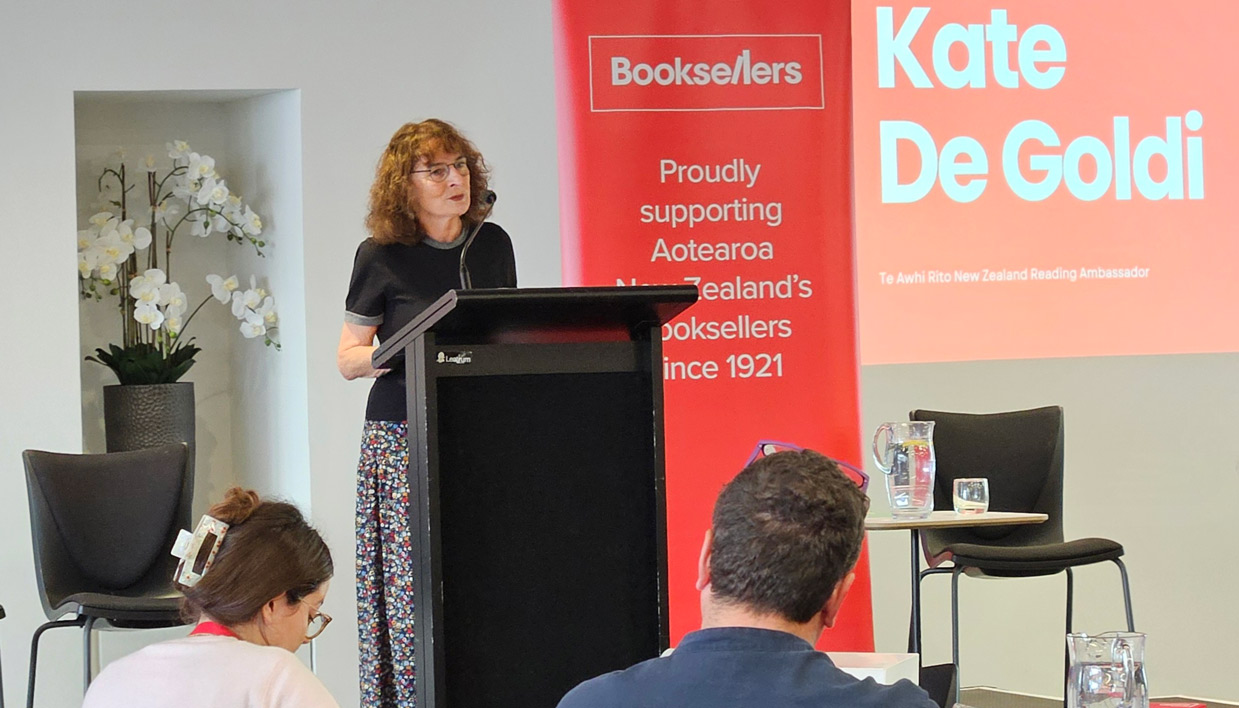
Image credit: Booksellers Aotearoa New Zealand.
I’ll begin with a poem that surely has great resonance for a gathering with books and reading at its heart. The poem is by Jenny Bornholdt and is called ‘In the Garden’.
In the Garden
In the garden
the bulbs run riot
root systems go
all over the place
we crack open huge dry
clods of earth and uncover
white bulbs of onion flowers
embedded like fossils
their roots like thin streamers
partying down through the soil.So we have a white flower
propped on the top of a green stem
a plain enough thing
while underneath
the feelers are out
hooking into other systems
forming the network
the flower an undercover agent
posted on the watch
a decoy of simplicity.
This is about the fecundity of garden soil, the miraculous interaction between soil nutrients and bulbs. But, it is also a beautifully wrought metaphor for the reading and writing process … That flower ‘posted on the watch’ is an analogue for language, for the power of words and sentences, story and verse. The poem suggests that, yes, the written word gives us straightforward, organised hieroglyphs on a page, describing thought or incident, but it suggests further that words are complex, resonating symbols; they throb with associations, memories, and sensory experiences. Words have root systems, as it were, roots with persistent streamers ‘partying down through the soil’ of our unconscious, making far-reaching connections. These are the connections that form our intellectual networks, that deepen our experience as sentient humans, that bring us to fuller, riper living.
I like to think of this poem as a hopeful epigraph hanging over this talk — a talk that the indomitable Renee Rowland has billed ‘War Cry’ — so my toggle will be between some tough thoughts and what I hope is a more buoyant call to action, for an insurgency that is increasingly urgent.
Festivals
Among much else across my first twelve months in the Te Awhi Rito role, I’ve participated in a number of book festivals — chairing and speaking. I like to think of this work as championing the act of reading, and the powerful charge of narrative, language and ideas in our culture.
And literature festivals are in demand across the motu, from the boutique — the RAWA festival in Akaroa — to the behemoth, Auckland Writers Festival (AWF) — both terrific in their different ways.
Festivals seem to me illustrative of both the wonders and great difficulties inherent in the book and reading ecosystem in Aotearoa. Apart from AWF which makes impressive profits — happily, ploughed back into literary projects — most festivals survive on some central and local government funding, sponsorship, philanthropic contribution and, of course, bookseller and publisher support.
But in a very real way, festivals exist because of thoughtful reading activists determined to bring writers and readers together; committed folk who do hundreds of hours of voluntary work, even when they’re salaried. It is a truth not necessarily acknowledged that a great amount of cultural innovation and labour in Aotearoa is carried out by an army of volunteers.
Writers
The other good news is that New Zealand writers keep on producing work of depth and stretch, invention and entertainment — an astonishing thing, possibly even a madness, given the odds stacked against a sustainable writing life in this country.
Poets young and old across our varied communities, in oral and written forms, continue to build a New Zealand poetry tradition that is, by any estimation, substantial. We have a lively non-fiction writing stream too, continually refreshing itself, taking risks with form and content, and feeding public discourse on important social-cultural-political matters in Aotearoa. As for fiction in all its genres, somehow novelists in Aotearoa still insist on signing up for that long immersive commitment, brought to the page by their particular, insistent preoccupations. I find it all a wonder …
Who will be the future readers?
But an almighty question hangs over these excellent publications, these lively festival gatherings and their stimulating conversations. It hangs, too, over Booksellers NZ. And PANZ. And the Book Awards Trust. And each and every ancillary organisation that contributes to the life of the book in Aotearoa — ReadNZ; Duffy’s Books; Storylines; Storytime; the Society of Authors, and others. Who in ten, 20, or 30 years’ time will be the audience for the books our writers create? Who will attend the literary festivals where our writers, and writers from across the world, speak? Who will buy the books our publishers produce and distribute and our booksellers hope to sell?
Serious challenges beggar our current reading ecosystem — increasingly fragile publishing and bookselling prospects; a fragmented infrastructure; a book reviewing and critical culture hanging on by its fingernails; diminished resourcing and much work required of organisations to obtain funding; persistent difficulties bringing NZ books to audience attention; and, I would suggest, the long shadow of settler culture and its legacy of privileging the physical and material over abstract thought and artistic expression. Despite an industry-wide habit of boosterism, the raw truth is that our book ecosystem is on a knife-edge.
But serious though these difficulties are, they constantly occlude that far more fundamental question. Will there be readers, constant or otherwise, in 30 years’ time? The answer to that question is enormously consequential for all of us here, and for our social and economic health as a nation.
I’ve always maintained a stubborn confidence in the future of books. Throughout its 2000-year evolution, the book has seen off numerous challenges. Despite predictions, even the eBook has been unable to vanquish the printed book. In a careless kind of way, I’ve always assumed there would be readers too — alas, a self-centred projection if ever there was one. The enormous amount of available data on reading tells another story altogether, one that pushes hard against our knee-jerk puffery.
Reading for pleasure research
It is that data that led eight years ago to a suite of reading and research initiatives developed by the National Library. These sought to address our reading crisis — and, it is a crisis, with implications largely unacknowledged or spoken about.
The resulting collective impact projects, which developed reading communities and research on reading for pleasure in New Zealand, were prompted by decades of international research. This research points firmly to what is needed to establish the habit of lifelong reading for pleasure and, further, what astonishing advantages accrue for individuals and communities where reading cultures are well established. The research also indicated that a public-facing role model can galvanise action around reading decline by building awareness of both reading’s critical role in education and life outcomes and, conversely, what is lost in our culture if reading continues to head south.
We need to advocate for reading more than ever
We live in interesting times — by which I mean a time of political fracture and systemic change. If we add to that the changes across the educational landscape and cultural infrastructure of Aotearoa and the rapid encroachment of AI, it seems more important than ever that there is an ongoing public voice for reading advocacy.
First and foremost, we need to advocate for reading as a medium for pleasure and stimulation, but also as fortification against societal developments that are surely epistemically compromising for our culture:
steeply declining concentration in our young
children’s — and many adults’ — shrinking vocabulary
a disturbing growth in anxiety disorders
the assault of pre-digested, misleading information
increasing groupthink, and
the decline of critical thinking faculties — at precisely the moment in history we need them most.
The role of Te Awhi Rito
The Te Awhi Rito kaupapa is to advocate for, model, and inspire reading in children, their whānau, families, and communities — in other words, everyone. This advocacy is part of the National Library’s aim to build a nation of readers.
The role is both iterative and cumulative. Our inaugural Te Awhi Rito, writer Ben Brown, emphasised during his tenure the twinned story and language cultures underpinning reading in Aotearoa; the oral tradition of te ao Māori and the print tradition of tangata Pākehā. He spoke powerfully about the primary need to sing, recite, share oral story, and read aloud to one’s children. His successor, school librarian Alan Dingley, criss-crossed the country talking to young people, educators and librarians about reading as the doorway to a lifetime of joy, growth, and wisdom.
I continue to build on and amplify Ben and Alan’s messages. But I’m also working to bring the advocacy to areas outside of education: community and sector groups such as yourselves, other service organisations, and the government sectors already involved in helping New Zealanders’ lives: local bodies, health, justice, arts and culture, business. Countering our reading decline will require a nationwide collective effort that considers every piece of the reading jigsaw. It’s particularly important that decision makers across all sectors are brought on board.
Access to books is crucial
To give you an example, I was told at a school library hui last year that school librarians’ greatest anxiety is the prospect of a change in school management. The sustainability of the library environs, the librarian’s job, and book budget is never guaranteed. And that’s leaving aside the schools where neither books, library, nor librarian exist, and whose students have limited or no access to public library services. Practically speaking, not every school in Aotearoa can provide a library (our country is dotted with small country schools). But ensuring ongoing access to books for children within the education system is critical for educational progress.
There are considerable inequities in access to books across our country. If we believe — as the research clearly demonstrates — that reading for pleasure is foundational for full literacy and therefore a crucial element in educational and life success; and if we believe that equity of access to reading material is the right of all children, then books in and through schools constitutes the vital link in the chain of access. It may be the only consistent access to books and the nurturing of a reading life for many, many children.
The decline in reading for pleasure
We know that reading for pleasure in Aotearoa begins to taper around nine years and enters a vertiginous decline in teenage years. There are numerous reasons for this, including families and teachers disengaging from reading once a child has learned to read alone. In fact, reading aloud and discussing books with children continues to be important well beyond a child’s attainment of basic literacy.
But there is strong evidence that reading has declined over every age group beyond adolescence in the last fifteen years. A complex interplay of factors is at work here, including gaping economic disparity, the growing burden of work across all communities; the aforementioned inequities in access to reading matter, the heavy socio-economic demands of parenting and family, a sharp increase in mental health problems.
Then there’s the formidable array of competing leisure alternatives – long-form television, video, YouTubing, gaming, to name just some; and not least, the advent of the smartphone and its enticements, resulting in the colonisation of sentient humanity! There is a clear correlation between the appearance of the smartphone and global reading for pleasure sharply declining.
The reading message needs to be powerfully communicated to adults who have left reading behind and are now, along with their children, at the mercy of algorithms, rolling news cycles, and an addictive ensorcellment by screens. If we lose adult readers, we lose a very important element of nurturing young readers — the modelling of reading: within families, schools, and beyond. It is certainly true that the literacy tail and reading decline are linked to poverty and inequity of access. But it is also true that families across all income brackets — including those with immense cultural capital — have, for all the cited reasons, allowed reading to slip away.
We know too that reading for pleasure has declined steeply amongst teachers — including English teachers. I’ve lost count of the number of teachers who have readily confessed they rarely read books now because — exhausted by a panoply of daily tasks and cognitive overload, increased numbers of students with learning difficulties and complex emotional needs, and the surging demands of the curriculum — it is so much easier to lose themselves in online scrolling. The same thing is happening with increasing numbers of public and school librarians. And these groups are three of the key agents in building cultures of reading amongst young people and their communities.
Consequences of the decline
A recent hair-raising article by Rose Horowitch, in The Atlantic magazine, detailed some of the more glaring consequences of global reading decline. It focused on American trends, but everything in the piece mirrored developments in Aotearoa:
Even the demographics that traditionally read the most — retirees, women, and college graduates — have seen a collapse in reading.
Increasing numbers of children in early education and school no longer hear the rhymes and folklore of their cultures; many don’t understand the mechanics of a book.
The books people do read are much simpler than they used to be. Bestsellers today have sentences around one-third shorter than a century ago.
Across age groups, genders, and education levels, people’s ability to think deeply about writing is diminishing. The higher-order abilities of comprehension and synthesis are being lost.
Why reading for pleasure?
The question humming beneath the Awhi Rito advocacy is, of course, why? Why reading for pleasure? And what exactly might one communicate to both communities and decision makers that will get them thinking about reading’s profound contribution to a burgeoning culture? Lifelong readers and those in the literacy, library, publishing and bookselling worlds have always been happily certain of reading’s enchantments and transformations. Unfortunately, earnest disquisitions about reading’s broad benefits have, until quite recently, proved unconvincing — basically unscientific — to those who believe reading for pleasure is little more than a passive recreational activity.
The wealth of research makes powerfully plain that reading for pleasure is fundamental to young people’s educational success, to the development of full critical and digital literacy and, ipso facto, to social, cultural and economic achievement and lifelong capital. Now we’re talking!
Further, and significantly given our beset contemporary world, we know that reading for pleasure builds empathy and contributes to sustained wellbeing across a lifetime. It also, crucially, builds the capacity for critical thinking — an essential skill for navigating a world now awash in disinformation and misinformation. Furthermore, a dedicated reading-for-pleasure habit is a more powerful determinant of a student’s success in life than their parents’ income.
What else is lost with reading for pleasure?
To consider this research evidence in another way and to confront the long-term realities of reading decline, the question might also be: what is lost if reading for pleasure is not part of young people’s lives, or the lives of their families and communities?
The American literacy academic Maryanne Wolf catalogues the losses in her pungent book, Reader, Come Home. Wolf lays out the revelatory findings from neuroscientists’ study of brain activity when children are reading or being read to: to put it crudely, it is all going fabulously bananas up there in the cranium. The neural circuitry is firing, furious decoding and analogic thinking are at work, intuitive leaps are being made; the brain is being fantastically exercised — pinging back and forth between prior and new knowledge, building complexity and nuance, examining, comparing, critically assessing. The brain is being terrifically expanded. In other words, a child nurtured in reading from birth is engaged in a powerful virtuous cycle, exponentially growing a reservoir of language and image, deepening intellectual and empathic capacity.
In a very real sense, they are constructing a singular identity and an independent belief system that arms them well for the challenges of an increasingly complicated, fractious world. And not least, the young reader-listener is learning the pleasures and fruitfulness of concentration, deliberation, and the enduring retention of what they’re drinking in.
Outsourcing thinking
But the neuroscience also tells us what happens when the brain is not fuelled and nourished by deep reading but pushed aside for the instantaneous, though fleeting, satisfactions of the digital world. Here, the twin constants are tsunamis of information — overload — and screens that encourage skimming, browsing, word spotting, infinite distractions, and ever-diminishing attention spans.
The sorry fact is that we are increasingly outsourcing our brains to outlets that offer the swiftest, most simplistic, most digestible distillations of information. The advance of AI is already accelerating this tendency and will only continue to erode thinking capacity. Put simply: when we outsource our thinking, our brains lie fallow. We retreat from complexity, our thinking narrows. And that narrowing is negatively exponential too: the less the brain is used, the more it loses plasticity and capacity. Horowitch’s Atlantic article reports that the decline of reading is concurrent with less rational, analytical, and sophisticated modes of thinking. At grave risk is the very ability to think for ourselves.
We live now in a decidedly digital world — and it’s undeniable that world offers advantages (for which I’m daily grateful). Maryanne Wolf’s cri de coeur is simply that we pay attention to the paradigm-shifting brain changes we’re all undergoing through prolonged and addictive digital engagement and return to reading for pleasure in order to restore a balance that’s become dangerously out of whack and is steadily corroding social and cultural cohesion.
What this means for publishing and bookselling
I don’t need to spell out the ramifications of all this for the business of publishing and bookselling.
I greatly appreciate that the challenges of your businesses are complex and the financial rewards vanishingly small; for many of you, mere survival hounds the daily toil. But it is blindingly clear, to me at least, that if we are to ensure the endurance of the component parts of our book culture, we need industry-wide recognition that a nationwide habit of reading for pleasure in Aotearoa is fundamental to any hope of our ecosystem’s recovery and growth. In other words, the book sector needs to be in closer conversation with the parts of the reading landscape that have, over the last twenty years, become fluent in the research around reading and the work needed to rebuild reading culture from childhood upwards.
We need to go back to the drawing board and reconsider the configuration of our book and reading world infrastructure. Aotearoa has a thoroughly admirable history of groups starting organisations to support the causes they believe in, and the evolution of the reading and book infrastructure certainly reflects this:
‘We need an organisation that takes writers into schools; rich kōrero between students and writer!’ Kia ora NZ Book Council, now ReadNZ.
‘We need an organisation that assists and promotes children’s writers – they simply don’t get the recognition and support they deserve!’ Hello Storylines NZ.
‘We need an organisation that protects writers’ work and rights; and maybe this organisation can also offer encouragement for emerging writers and build earning capacity for established writers through manuscript assessment and mentoring.’ Mōrena Society of Authors.
‘We need an organisation to supply books to homes, and a second organisation that does the same, only very slightly differently, and perhaps a third organisation that gives books to newborn babies. Poetry needs its own day in the sun. Bookshops, too, need a designated day to raise awareness and encourage public patronage.’ Kia ora Duffy Books in Homes, Storytime Foundation, National Poetry Day, Bookshop Day.
‘We must coalesce some of these organisations for more heft.’ Welcome Coalition for Books.
Every one of these organisations springs from and is sustained by people who believe in the potency of a reading culture, who think and care, and embrace a working life that is fuelled less by a pay packet than a sense of vocation. I salute all of you. And tautoko to Melanie Laville–Moore and her team for the heroic effort with Mahi Tahi Work Together; ka aroha for the cloth ears into which it fell … And how very dispiriting to read the recent Booksellers Aotearoa New Zealand report.
But for all this dedicated mahi and the efforts at collectivism, we’re on a downward spiral. Our commendably collegial but problematically siloed reading and book ecosystem consistently resists efforts at high-level strategic rethinking. No one’s fault, particularly — we’re all utterly preoccupied with the survival of our individual corners of the landscape. And the competition for funding leads to a kind of turf and brand protection, and a compulsion to create ever-new initiatives signalling to funders our respective effectiveness and worth. All this effort comes from a place of deep dedication, but there is unhelpful duplication and, alas, so much of the activity is neither sufficient nor sustainable.
What do we do?
I’m increasingly persuaded that the mission to rebuild a nation of readers needs to be the basis and driver of a determined pivot in our thinking and activity. I would argue that to achieve the recovery and uplift of our sector, the most persuasive narrative at hand — for decision makers, funders, and the public — is one that makes clear and urgent the signal importance of reading and access to books for thriving individuals and communities; a narrative that spells out the profound — indeed existential — implications for our wider culture, the country’s prosperity, and our very democracy if reading culture is not recovered and strengthened.
A wide and deep reading citizenry (as we once rightly considered ourselves) has the capacity to reflect and connect and discern, to think its way cooperatively through problems of inequality and productivity, social fracture and economic complexities, climate crisis and global relations; it is our collective capacity to focus, analyse, reason and act that will build a cohesive, prospering society.
The good news is that we have at hand so much knowledge about how to reboot a reading culture.
First up: building a nationwide understanding of the state of play, the research data, and evidence-based proposals for action. Sharing that message is certainly part of the Awhi Rito kaupapa, but the gathered knowledge is available to everyone. All of you — important players in the reading landscape — are, through your working and personal lives, reading ambassadors too.
Read the aforementioned Reader, Come Home. It should curl your toes and fire your blood.
Read The Enchanted Hour by Meghan Cox Gurdon — a book that illustrates so powerfully, and with robust evidence, the extraordinary power of reading aloud in an age of dementing distraction.
Read Rose Horowitch’s article in The Atlantic. Read Frank Cottrell Boyce’s book A British Childhood, a stirring reflection on his two years as the UK Children’s Laureate that digs into today’s multiple barriers to reading; it is certainly relevant to Aotearoa.
Read the rich resources freely available on the National Library’s website, which include much research evidence and the multiple ways to build reading for pleasure in the home, in communities, and in schools.
Points of entry for strategic change
All these affirm that a reading insurgency requires strategic change from a dozen different points of entry, including:
Empowering families and schools through equitable access to books; books in te reo Māori, the languages of tangata moana, and the home languages of other New Zealanders — books that reflect the lives of all young people in Aotearoa, and books that enlarge their understanding of other people and other worlds.
Building parents and caregivers' understanding of reading’s horsepower so they are encouraged to place reading for pleasure at the heart of their children’s life and learning (and bring the adults back to reading themselves).
Supporting our early education sector and schools to seed and grow reading cultures that provide inspiring role models, that strengthen reading aloud and reading for pleasure in the classroom.
Supporting and strengthening our truly excellent public library systems — whose status and resources are never guaranteed.
Working with government services to grow understanding of reading for pleasure’s contribution to recovery, wellbeing, and the emotional sustenance of individuals in need.
Supporting publishers to bring forth the books that fuel the reading lives of our children – those books in multiple languages, but also books across a wide variety of forms — poetry, fiction, narrative non-fiction, picture books, graphic story — to feed all reading appetites. A reading life will always encompass multitudes, but the acceleration of fast publishing has meant an oversupply of formulaic, arid books for young readers, books crowding out titles that provide challenge and extension alongside immersion and delight. We need adventurous, creative, brave publishing that prods and stimulates our potential readers, not great quantities of formula led by algorithms and the market’s lowest denominators.
Encouraging booksellers to be similarly adventurous with the reading material they stock — to read and engage imaginatively with their books, and lead readers to them. I recognise publishing and bookselling’s bottom-line imperatives loom ever larger. But I think the vexed equations of the book economy have pushed booksellers into ever more conservative decisions around what they stock, and how long they hold that stock. Books, especially lesser-known books that ask more of readers, need time to percolate through the community consciousness. Reaching beyond the obvious titles and championing new and older books of enduring quality — particularly for young people — will build a dynamic, nuanced, rich reading culture.
Asserting a cultural narrative from bottom up and top down that recognises, respects, and champions the essential role the language arts — literature, writing, oratory, poetry, drama — play in a flourishing society.
Above all, arguing for that which is foundational to all of this: funding for the component parts of our reading infrastructure. This will be a decisive contributor to building a nation of readers. Clearly, we have a large job of work to do in that regard — a fully cohering sector with an insistent collective voice is, I would suggest, our best hope.
Recentring of reading in the lives of New Zealanders
It is certainly not my place to instruct any of you or your organisations on the detail of how you might insert yourselves into this much-needed reading insurgency. That is for each part of the sector to consider and plan, knowing your particular territories and their exigencies as you do.
My intention today is to argue that we are at a vital inflection point in regard to the place of reading, oral/aural fluency and thinking in our culture. And that the recentring of reading in the lives of New Zealanders is central to the survival of our book and reading ecosystem. At this fretful moment in history, the book sector is more important than it has ever been. There is no easy fix for its dilemmas, but for sure, the chance of a turnaround requires the sector to pull together, to have extensive, searching kōrero, to consider how our multiple services can work in more effectively joined-up ways to build a long-term plan for the reading insurgency and sector reorientation.
We need to assert ourselves against the narrative that views the health and wealth of a nation in determinist, mechanistic outputs and economic terms alone. A country is a community of thrumming human possibility that needs the nourishment of language and story to thrive, flex, and imagine a future for all of us.
Becoming reading champions
Meanwhile, in our personal lives, surely all of us can benefit from some hard thinking about our own relationships with reading? How’s that going, here in 2026? If we were to range over our reading lives in the last fifteen years, what might we discover? Is long-form reading a vibrant part of our weekly round? Or has screen life muscled its way in and taken up the glass of time — to borrow Anne of Green Gables’ immortal phrase (courtesy of Tennyson). If the habit of reading books has receded, how might we coax it back?
And how might you energetically advocate, spread the reading message? By engaging with people! — friends, dinner and holiday companions, family across the generations, colleagues — about the power reading has in individual lives and communities, its capacity for rescue and repair in our harried, digital world. Share your reading life with people — particularly the young; tell them what individual books mean to you. Tell them about Reader, Come Home, and The Enchanted Hour and the other stirring narratives.
And suppose those you interact with ask, ‘What exactly is reading for pleasure and what happens when we do it?’ Putting the neuroscience to one side and thinking of the experience in more recognisable and perhaps more inspiring terms, here’s how I think of it:
This is reading motivated by our own desires: for entertainment and comfort and escape, for understanding, stimulation, reflection, and imaginative stretch. It’s the reading that takes place happily alone and immersed, propelled by curiosity, spellbound by story and language. We read to find out. We hoover up narrative that reflects our reality and dreamscapes and throws a light on the lives of others. Our humanity and our world are both explained, and their mysteries productively deepened.
Reading for pleasure is both joy and incitement; our enquiries expand, our language bank surges, our empathy is powerfully aroused and sustained. We emerge subtly changed, lit up, creatively disturbed, emboldened by new thinking. We need to tell someone else. We need them to know, we need to connect … And with connection, reading becomes twice powerful — when we connect with others over reading, we’re making the first steps in creating a reading community, in watering the seeds of a nation of readers.
Reflection: Some prose and a poem
I’ll leave you now with a paragraph and a poem, distilled writings saying it all — uneasy, sorrowful, resonant … but, I hope, catalyst, and incitement too.
In 1985, the American educator Neil Postman published the book Amusing Ourselves to Death, a powerful argument against television’s deadening and corrosion of what he called the typographical mind (the mind formed by sentences, paragraphs, arguments, narratives, in print). The book is eerily prescient about the depredations of the coming digital age — an urgent reminder of intellectual decay in our current world.
‘We were keeping our eye on 1984’, Postman wrote in his foreword,
‘When the year came and the prophecy didn’t, thoughtful Americans sang softly in praise of themselves. The roots of liberal democracy had held … we, at least, had not been visited by Orwellian nightmares.
But we had forgotten that alongside Orwell’s dark vision, there was another — slightly older, slightly less well known, equally chilling: Aldous Huxley’s Brave New World … Orwell warns that we will be overcome by an externally imposed oppression. But in Huxley’s vision, no Big Brother is required to deprive people of their autonomy, maturity, and history. People will come to love their oppression, to adore the technologies that undo their capacities to think.
What Orwell feared were those that would ban books. What Huxley feared was that there would be no reason to ban a book, for there would be no one who wanted to read one.’
And, finally, a poem from Bill Manhire’s remarkable final collection, Lyrical Ballads. The poem limns the great sadness of leaving the world behind, but both the title and organising metaphor suggest that our poet is mourning another kind of ending too.
Library Song
The man from the Ministry of Health
has placed my books upon his shelf.
Sometimes he takes one down for me
if I sit where he can see.
He does not read books much himself.This is a happy time,
especially when the day clouds over.
I hold the book all day, all day,
until the time for reading’s over.His name is Mr Crimson
though the colour of his heart is grey.
I ask him if it is true about his heart
but he says he has not looked and so he cannot say.He says, The time for reading is over
for the daylight is nearly gone.
This book must now return
to the shelf it rests upon.The man from the Ministry of Health
has taken my book from me.
He has placed it on the high shelf carefully
with all the other books he has taken away from me.
Works cited
Bornholdt, Jenny. ‘In the Garden’, Selected Poems. Te Herenga Waka University Press, 2016.
Cottrell-Boyce, Frank. A British Childhood: How Our Children Live Now. Picador, 2026.
Cox Gurdon, Meghan. The Enchanted Hour: The Miraculous Power of Reading Aloud in the Age of Distraction. Little, Brown Group, 2019.
Horowitch, Rose. The end of reading is here. The Atlantic, August 2026.
Manhire, Bill. ‘Library Song’, Lyrical Ballads. Te Herenga Waka University Press, 2026.
Postman, Neil. Amusing Ourselves to Death. Viking Penguin, 1985.
Wolf, Maryanne. Reader, Come Home: The Reading Brain in a Digital World. HarperCollins, 2018.
Reading engagement — National Library of New Zealand | Te Puna Mātauranga o Aotearoa.